 |
Fractal Grower
Java Software for Growing Lindenmayer Substitution Fractals (L-systems).
|
By Joel Castellanos,
Department of Computer Science, University of New Mexico
Funding for continued development of Fractal Grower is being provided by the
Fractal Foundation of Albuquerque, New Mexico.
An L-system is a formal grammar most famously used to model
the growth processes of plants. Changes to the gallery of preset parameters
will quickly yield beautiful fractal images of such variety that it is unlikely
what you create has ever been seen before. Save your creations and add them to the gallery.
 Click here to download and/or run FractalGrower in the JRE Version 2010-03. After downloading, find the directory where you saved FractalGrower.jar. Double click on it to run FractalGrower.
Fractal Grower requires Java Runtime Environment (JRE) 1.5 or newer.
Going Deeper:
You can take the patterns to a greater number of levels by running FractalGrower with more memory: from the command prompt, change to the download directory and use the command: java -Xmx135m -jar FractalGrower.jar
 |
 |
|
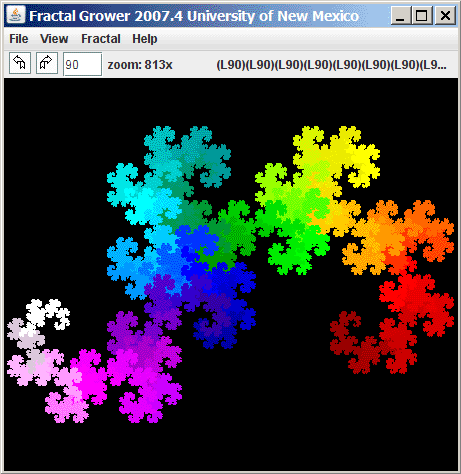
Level 17 of the Dragon - a Paper Folding Fractal pattern
that results from folding a strip of paper exactly in-half seventeen times,
and then opening it up so that each fold makes a 90° angle.
|
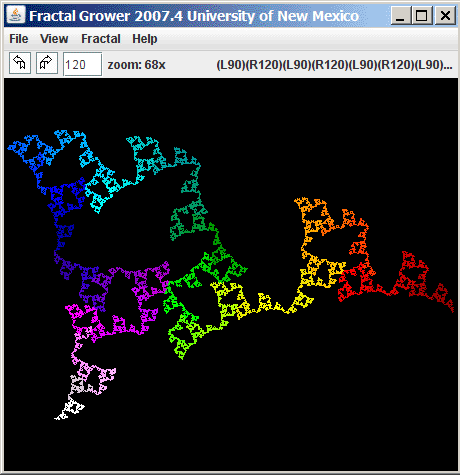
Level 11 of a Paper Folding Fractal that results from
Alternating between folding to the Left at 90° and then to the Right
at 120°. Always folding exactly in-half.
|
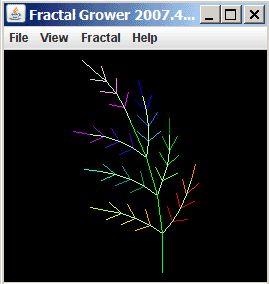
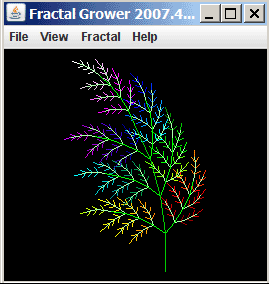
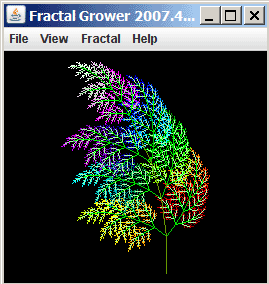
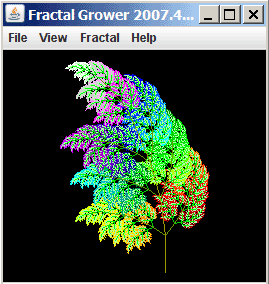
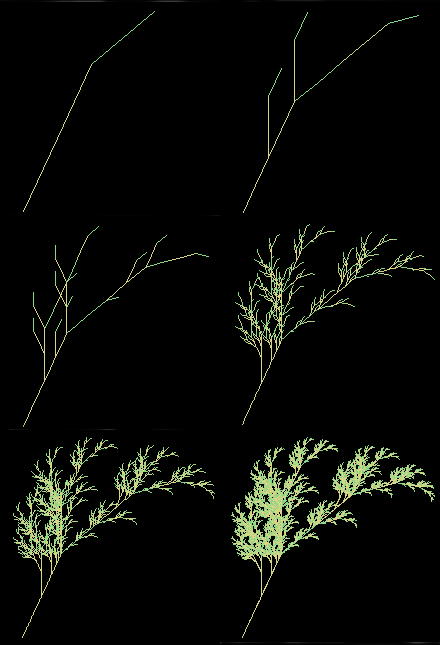
Levels 1 through 5 of an L-system fractal with the substitution rule:
f=![+++++f][-------f]-![++++f][------f]-![+++f][-----f]-!f
Paper Folding Fractals:
Constructing The Dragon:
Step by step process of constructing the first few levels of the Dragon
fractal from an 11 inch strip of paper.
Chasing the Dragon:
Development of a symbolic representation of paper folding that can be programed
on a computer.
Other Paper Folding Fractals:
Fractals that result from alternating between left and right folds, and
folds of various angles.
L-Systems:
Further Reading:
The paper folding part of the software and documentation are based on a lecture
given at Rice University in the spring of 1994 by
Heinz-Otto
Peitgen of the CeVis
Research Center at the University of Bremen, Germany. CeVis is
well known for its many documents concerning Chaos Theory and Fractal Geometry.
Several books are available which offer an easy-to-understand introduction
to these topics. Besides that, there are several video films available.
- Peitgen, H.-O., Jürgens, H., Saupe, D.: Chaos
and Fractals, Springer-Velag New York, inc., 1992
- Peitgen, H.-O., Richter, P.: The Beauty of Fractals,
Springer-Verlag, Heidelberg, 1986
- Peitgen, H.-O., Saupe, D.: The Science of Fractal Images,
Springer-Verlag, New York, 1988
- Gary William Flake: The Computational Beauty of Nature,
The MIT Press, Cambridge, Massachusetts 1999
